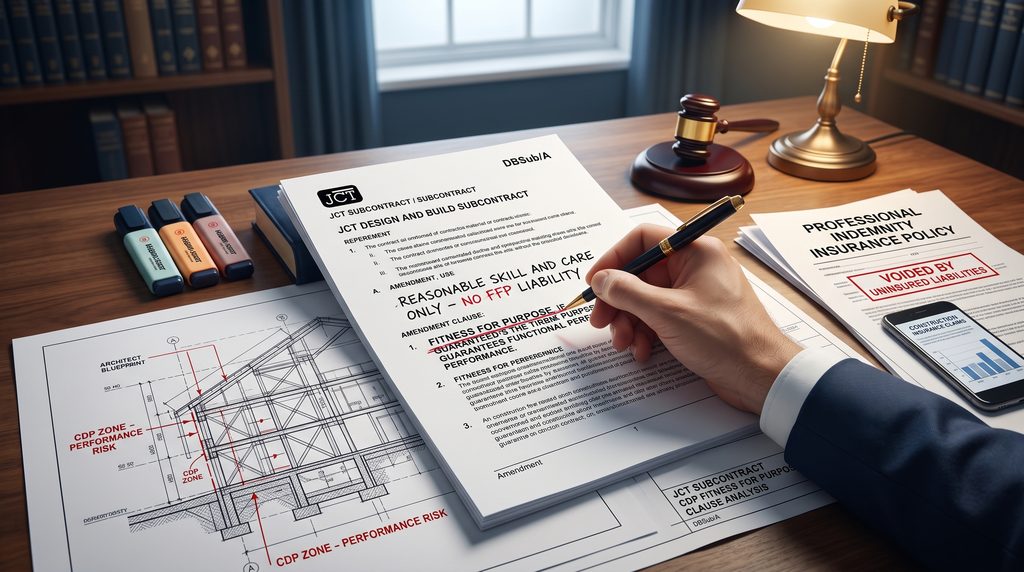
When a trade contractor signs up to Contractor’s Designed Portion (CDP) works under a standard JCT Design and Build Subcontract (such as DBSub/A or SBCSub/A), the baseline legal standard for design is straightforward: reasonable skill and care.
However, main contractors routinely slip bespoke amendments into Section 2 and collateral warranties that elevate that duty to an absolute fitness for purpose obligation.
This single amendment creates one of the most dangerous commercial exposures in UK construction. It can instantly invalidate your Professional Indemnity (PI) insurance and leave your business defending catastrophic structural or performance claims out of pocket.
Reasonable Skill and Care vs Fitness for Purpose: The Crucial Distinction
To understand why main contractor commercial managers push this amendment, you must understand the legal divide:
Reasonable Skill and Care (Standard JCT Baseline): You are judged against the standard of an ordinary, competent professional designer or engineer (the Bolam test). If a design element fails despite you following established codes of practice, statutory guidance, and industry standards, you are not negligent, and your PI insurance responds.
Fitness for Purpose (Bespoke Amendment Trap): You guarantee that the completed installation will achieve a specific functional result or performance criteria, regardless of unforeseen factors, manufacturer defects, or external variables. If it fails, you are in strict breach of contract—even if you exercised exemplary skill and care.
| Legal Standard | Standard JCT Default | Main Contractor Amendment | PI Insurance Cover? |
| Reasonable Skill & Care | Yes (Clause 2.17 / 2.19) | Often struck out or diluted | Covered |
| Fitness for Purpose | No | Inserted via Schedule of Amendments | Excluded / Uninsured |
Why Fitness for Purpose Destroys Your PI Insurance
The fundamental problem with a fitness for purpose warranty is that standard Professional Indemnity policies in the UK strictly cover claims arising from negligence.
When you contractually agree to an absolute fitness for purpose standard, you accept strict liability beyond common-law negligence. If a performance defect occurs:
- The main contractor issues a formal claim under your amended JCT subcontract.
- You notify your PI insurer.
- Your insurer’s legal team reviews the contract amendments, identifies the uninsurable fitness for purpose warranty, and declines the claim under standard policy exclusions.
- Your company is left to self-fund the rectification costs, consequential damages, and dispute resolution.
Sneaky Ways Main Contractors Smuggle Fitness for Purpose into JCT Subcontracts
Main contractors rarely use the exact heading “Fitness for Purpose”. Instead, look out for these three drafting mechanisms:
The Employer’s Requirements Performance Hook: Subcontract wording stating that the subcontractor warrants its CDP works will “satisfy all performance specifications and operational outcomes set out in the Employer’s Requirements”.
Dual-Standard Qualification Clauses: Clauses that mention “reasonable skill and care”, but follow with: “…and without prejudice to the generality of the foregoing, the Subcontract Works shall be fit for their intended purpose as stated in or inferred from the Subcontract Documents.”
Back-to-Back Collateral Warranties & Third-Party Rights: Agreeing to standard skill and care in the subcontract body while executing a collateral warranty in favour of the funder or employer that contains a strict fitness for purpose covenant.
How to Fix and Qualify the Clause Before Signing
Never accept an amendment that elevates design liability above reasonable skill and care. When issuing your tender qualifications or redlining the Schedule of Departures, use the following benchmark amendment:
Recommended Tender Qualification / Redline:
“Notwithstanding any other provision in this Subcontract, the Employer’s Requirements, or any Collateral Warranty, the Subcontractor’s liability in respect of any design carried out by or on behalf of the Subcontractor shall be limited to exercising the reasonable skill, care, and diligence to be expected of a qualified and competent professional designer undertaking design of a similar nature, value, and complexity. The Subcontractor gives no warranty or guarantee that any design or works shall be fit for purpose.”
CDP fitness for purpose clauses void standard UK PI insurance. Learn how to redline design terms to reasonable skill and care.
Audit Your Subcontract Before You Commit
Fitness for purpose amendments are just one of several severe traps main contractors insert into standard JCT forms. Other common pitfalls include uncapped liquidated damages indemnities, deemed concurrence bars on loss and expense, and pay-less evasion.
Before signing your next project order, run your schedule of amendments through my automated risk scanner at Trade Contracts Simplified. Get an instant, solicitor-grade risk report highlighting your commercial exposures in plain English with ready-to-use redline amendments.